AI Adoption Fails in the Middle
Team leaders decide whether enterprise AI becomes everyday operating practice.

A familiar AI adoption pattern looks healthy from a distance.
Executives want a credible answer to the AI question. Employees are already experimenting in small ways: drafting emails, summarizing documents, generating code, comparing policies, cleaning up meeting notes.
There is sponsorship at the top and curiosity at the edges.
Then the rollout slows down.
Usually not because the board lost interest, and not because employees saw no value. It slows because the middle of the organization has not changed: the team leads, product owners, department heads, engineering managers, process owners, and operations leads who turn intent into daily work.
That is where AI either becomes part of the operating system, or remains a collection of side experiments.
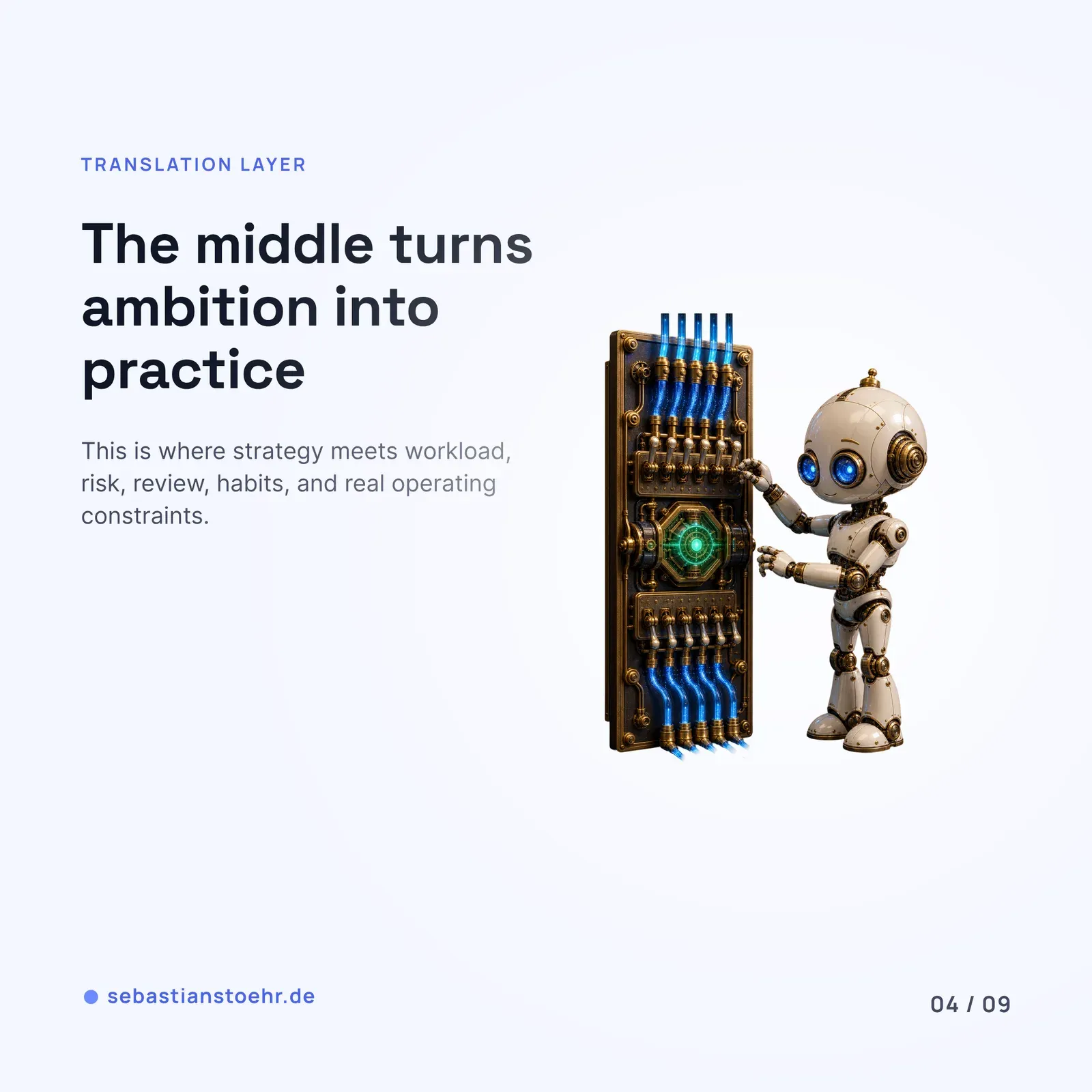
The middle translates ambition into practice
Most real work does not happen inside strategy documents. It happens inside teams, queues, rituals, reviews, handoffs, exceptions, and deadlines.
That layer is managed by people who are - often - not properly included in AI transformation processes. They decide whether a new AI-assisted workflow fits the way the team works. They notice whether review takes longer than doing the task. They hear when employees are confused by policy. They know which exception cases ruin a clean demo. They can tell whether a tool reduces friction or just moves it somewhere else.
If this group is not equipped, AI stays abstract.
The top says “we need adoption.” The bottom says “we found some useful tricks.” The middle is left to reconcile ambition, risk, quality, workload, and existing commitments without a clear operating model.
That is where things get stuck.
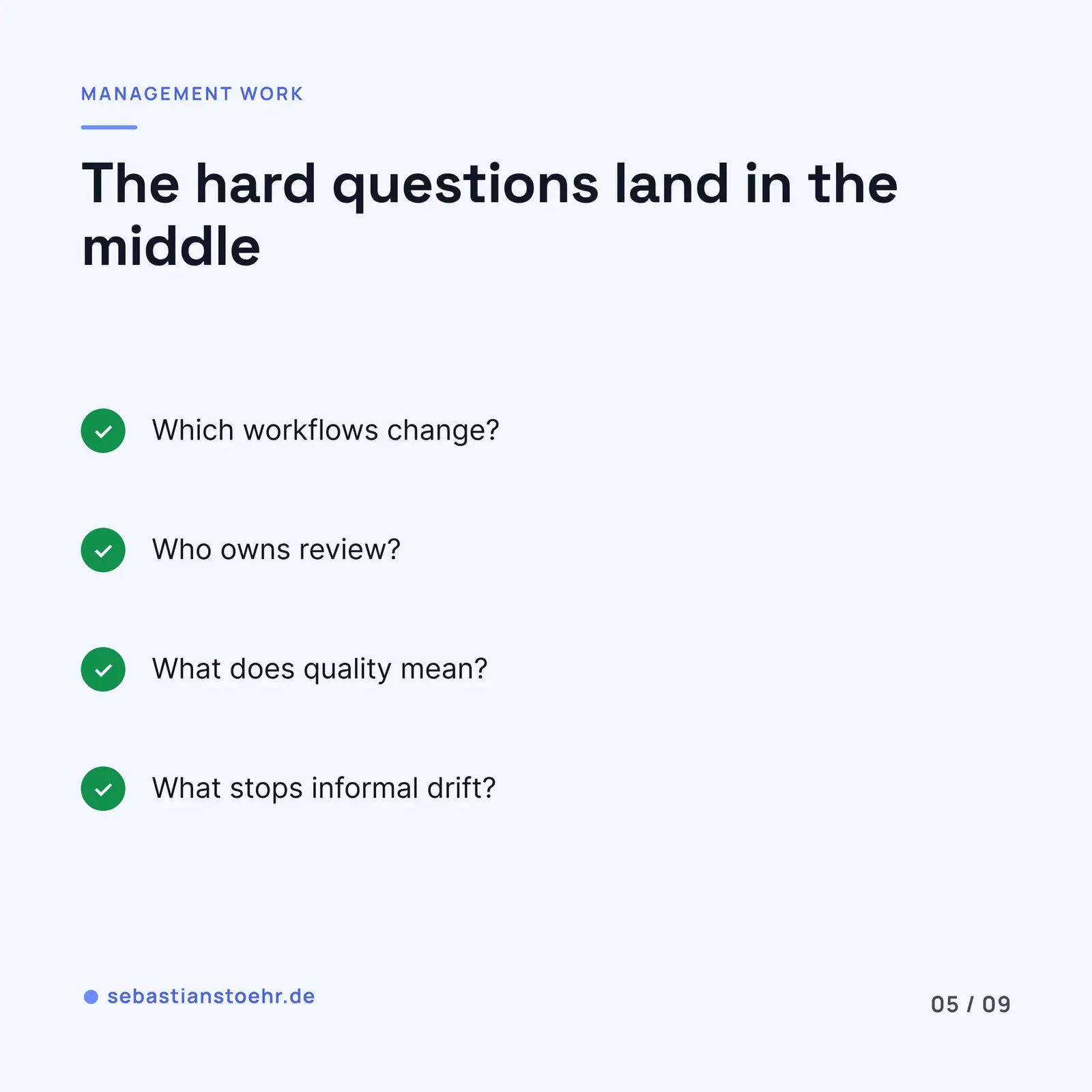
Managers inherit the messy questions
The strategic AI conversation is often cleaner than the operational one.
At the strategy level, AI improves productivity. At the team level, someone has to decide whether an AI-generated customer response can be sent, whether a summary is good enough for a decision, whether a workflow needs approval, whether a prompt belongs in a shared template, and who fixes the process when it stops working.
Those are not glamorous questions. They are the questions that determine adoption.
A manager may believe in AI and still hesitate because the practical answers are unclear:
- Which tasks should the team use AI for?
- What data is allowed?
- What output requires review?
- How do we avoid two people solving the same problem twice?
- How do we know whether quality improved or only speed increased?
- What do we stop doing if AI saves time?
- Who owns the new workflow after the enthusiastic person moves on?
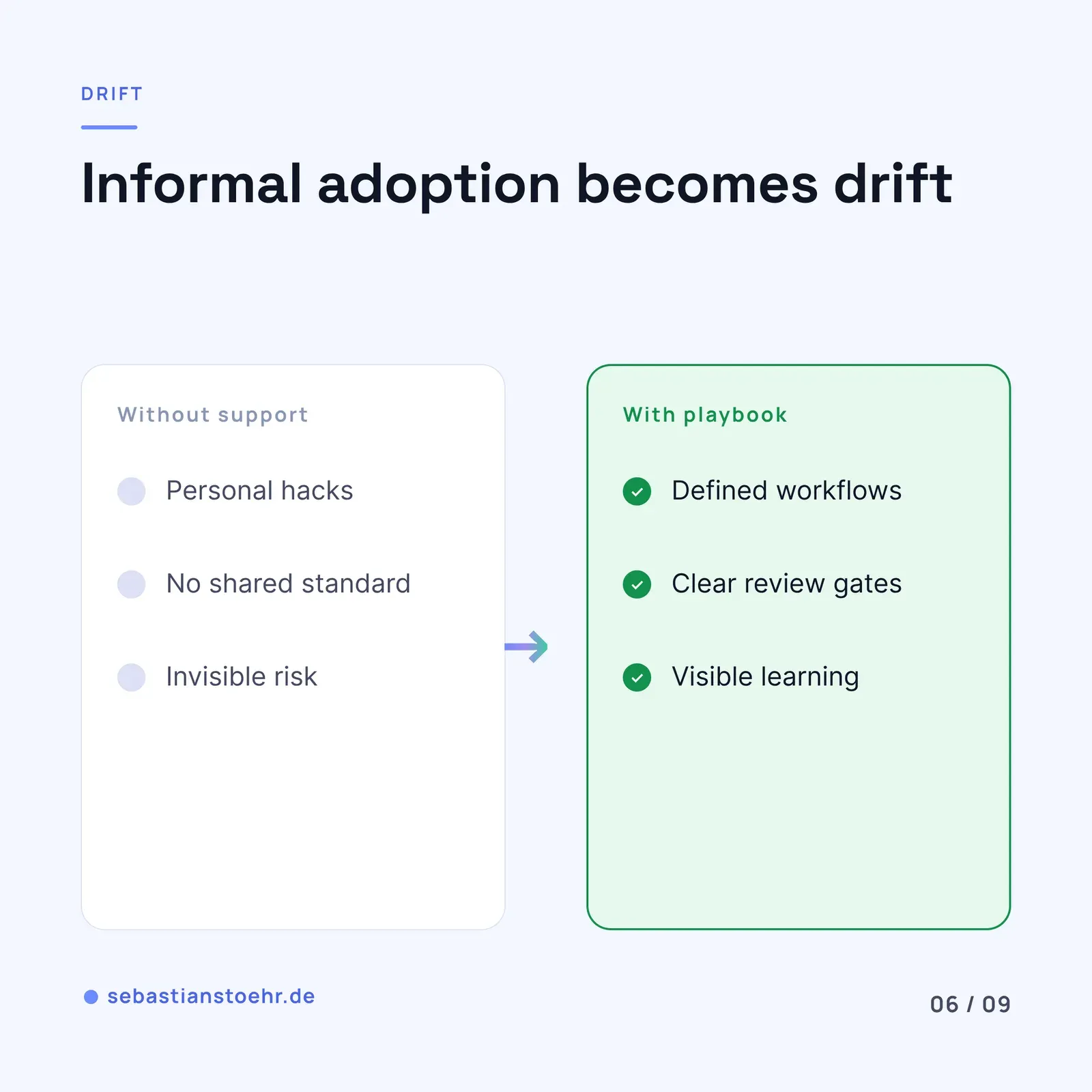
Without support, managers do the safest thing. They let experimentation happen informally, but avoid making it part of the official process.
That looks like adoption from a distance. Up close, it is drift.
The incentive problem
There is another reason the middle matters: incentives.
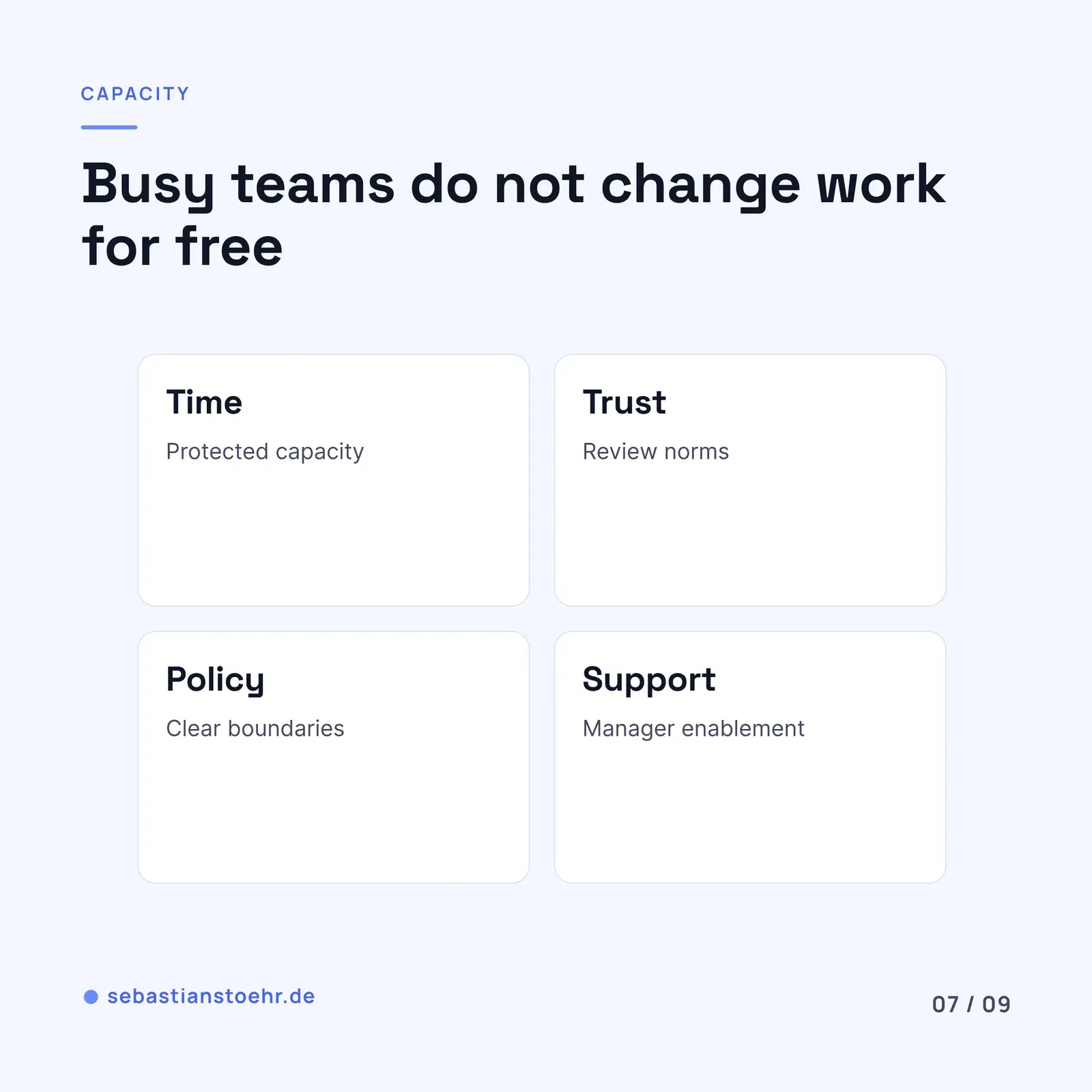
AI adoption asks teams to change how they work while still delivering the work they already committed to. Experimentation competes with deadlines. Documentation competes with throughput. Sharing patterns competes with solving the immediate local problem.
If a team lead is measured only on short-term delivery, they may not spend time turning a useful AI trick into a shared workflow. If a department head is punished for risk but not rewarded for learning, they will default to control. If managers do not get time to redesign work, they will add AI on top of the old process and call it transformation.
The result is predictable: busy people use AI individually, but the organization does not learn collectively.
That is not a tooling problem. It is a management system problem.
What the middle needs
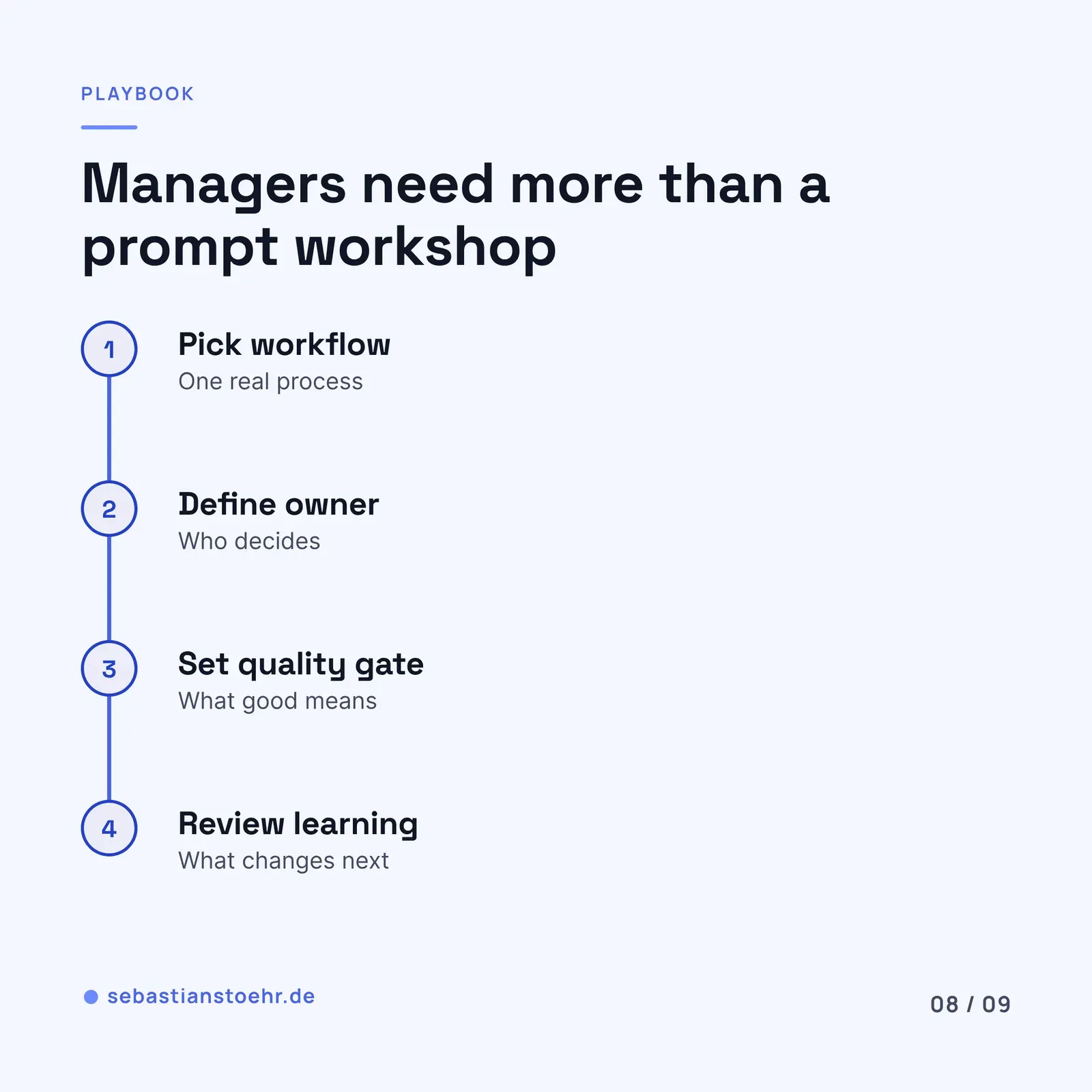
The answer is not to send every manager to a prompt engineering workshop.
They need a practical playbook for AI-enabled work.
That playbook should help them answer concrete questions:
- Which recurring work in this team is worth improving?
- Which parts are safe to automate, assist, or draft?
- What does good output look like?
- Who reviews the output, and how much review is acceptable?
- What examples should we keep to test quality over time?
- What should be shared with other teams?
- When does this need stronger controls?
They also need room to experiment and the safety to learn in public. Finding the right AI workflow takes trial and error. If a manager is penalized because a pilot automation falls flat or needs immediate correction, they will quickly retreat to the status quo.
If AI reduces drafting effort but the same approval chain remains untouched, the benefit may disappear. If a summarization workflow saves time but nobody changes meeting habits, the team may just produce more summaries. If a triage assistant improves classification but no one measures handoff delays, the organization may miss the value.
Simply using a tool is just the beginning; real adoption happens when business processes actually improve.
The role of central teams
Central AI teams should not try to own every use case. That turns them into a bottleneck.
Their more useful role is to make the middle layer better at owning the right things.
Give managers safe defaults, example workflows, review patterns, escalation paths, reusable templates, and a place to share what works. Help them distinguish harmless experimentation from workflows that need real controls. Collect patterns and turn them into assets other teams can reuse.
Do not remove ownership from the business. Raise the quality of ownership inside the business.
That is how AI adoption becomes scalable without becoming chaotic.
 From AI Tool Chaos to an Enterprise AI ToolboxMost enterprises start their AI journey as scattered, unmanaged experiments. That's not a failure – it's the raw material. The hard part is building a bridge from local chaos to shared capability without killing the learning in the process.sebastianstoehr.de
Look at the middle
When AI adoption feels slower than expected, it is tempting to blame tooling, policy, or employee resistance.
Sometimes those are real issues. But often the missing layer is the one in between: the people responsible for turning strategy into daily practice.
If they are unsupported, AI remains either a top-down ambition or a bottom-up habit.
If they are equipped, AI can become something more useful: a normal way of improving work.
The middle is not where transformation slows down because people are blocking it. It is where transformation becomes real or stays performative.
AI adoption fails in the middle

The post in a nutshell
Why does enterprise AI adoption stall after the pilot phase?
AI adoption often stalls in the middle of the organization — the team leads, product owners, department heads, engineering managers and process owners who turn intent into daily work. With sponsorship at the top and experimentation at the edges but no operating model in between, AI stays a collection of side experiments rather than part of how the work is done.
What do team leads actually need to decide before AI becomes part of a team's process?
Team leads inherit the operational questions the strategy deck does not answer: which tasks the team should use AI for, what data is allowed, what output requires review, how to avoid two people solving the same problem twice, and who owns a new workflow after the enthusiastic person moves on. Without support, most managers let experimentation happen informally but keep it out of the official process — which looks like adoption from a distance and is drift up close.
How do delivery incentives block AI adoption in teams?
AI adoption asks teams to change how they work while still delivering what they already committed to, so experimentation competes with deadlines and sharing patterns competes with solving the immediate local problem. A team lead measured only on short-term delivery has little reason to turn a useful AI trick into a shared workflow, and a department head punished for risk but not rewarded for learning will default to control.
What should a central AI team do instead of owning every use case?
A central AI team that tries to own every use case becomes a bottleneck. The more useful role is to raise the quality of ownership inside the business: safe defaults, example workflows, review patterns, escalation paths, reusable templates, a place to share what works, and help distinguishing harmless experimentation from workflows that need real controls.