From AI Tool Chaos to an Enterprise AI Toolbox

Walk into most companies eighteen months into their AI journey and you won’t find a strategy. You’ll find a mess.
One team drafts everything in ChatGPT. The developers are on Copilot. A product manager swears by Claude for research. Someone in ops has a script nobody else knows about. A data team is quietly prototyping a retrieval assistant against internal docs. And in a meeting room down the hall, legal, security, and procurement are trying to work out what, exactly, is already happening on their watch.
I want to say something that isn’t fashionable: this is fine. It’s not a governance failure. It’s the normal first chapter, and trying to skip it usually does more harm than the chaos itself.
But it can’t be the last chapter. The interesting question, the one this piece is about, is how you get from scattered experiments to shared capability without crushing the very curiosity that got you the experiments in the first place.
Why the chaos is actually useful
New capabilities almost never enter an organisation through a clean operating model. They arrive through curiosity and local problem-solving. The barrier to AI is unusually low (a browser, a subscription, a real task), so the people closest to the work find uses that no central transformation team would ever surface in a workshop.
Support discovers it’s good at summarising long case histories. Finance starts comparing policy documents with it. An engineer uses it to make sense of legacy code nobody wants to touch. None of that needed a steering committee.
That decentralised poking-around matters because AI adoption isn’t really a tooling rollout. It’s a learning process. Teams have to find out for themselves where the technology genuinely helps, where it quietly introduces risk, and where their own data and workflows simply aren’t ready yet. Standardise too early and you freeze that learning before anyone understands the real demand: you pick the tool that looks good in the vendor demo, write a policy nobody can follow, and push the actual experimentation underground where you can’t see it.
A degree of chaos is a sign of engagement, not dysfunction. The problem is never that it starts. The problem is when it never ends.
What unmanaged sprawl actually costs
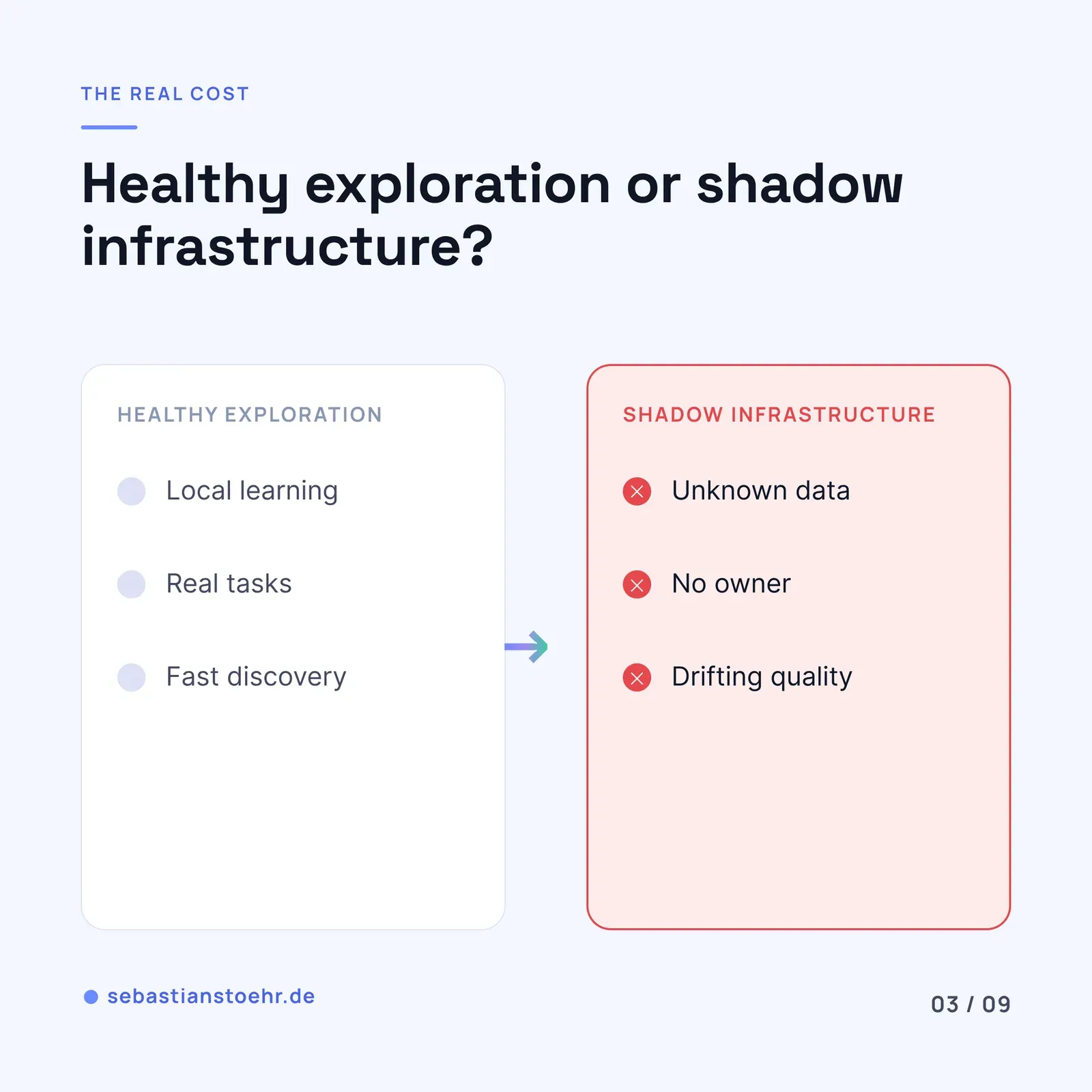
Left alone too long, the mess stops being healthy. The failure modes are predictable, and most of them are about invisibility rather than any single dramatic incident.
Sensitive data goes into tools never cleared for it, and worse than the exposure is that you often can’t reconstruct where it went or under what terms. Three teams independently build almost the same proposal-drafting workflow, and the organisation captures none of it as reusable. Quality drifts: one team has serious human review, another ships raw output into customer-facing work, and “good AI-assisted work” means something different in every corner of the building. And when one of these workflows quietly becomes business-critical, nobody owns it. It’s shadow infrastructure: useful right up until it breaks, goes stale, or fails an audit.
The deepest cost is trust. Employees who hit unreliable tools and contradictory rules get cynical. Leaders who only ever hear success stories, with no view of adoption, risk, or measurable outcome, get cautious. Adoption then stalls, not because the technology is weak, but because the operating model never showed up.
The over-correction is just as bad
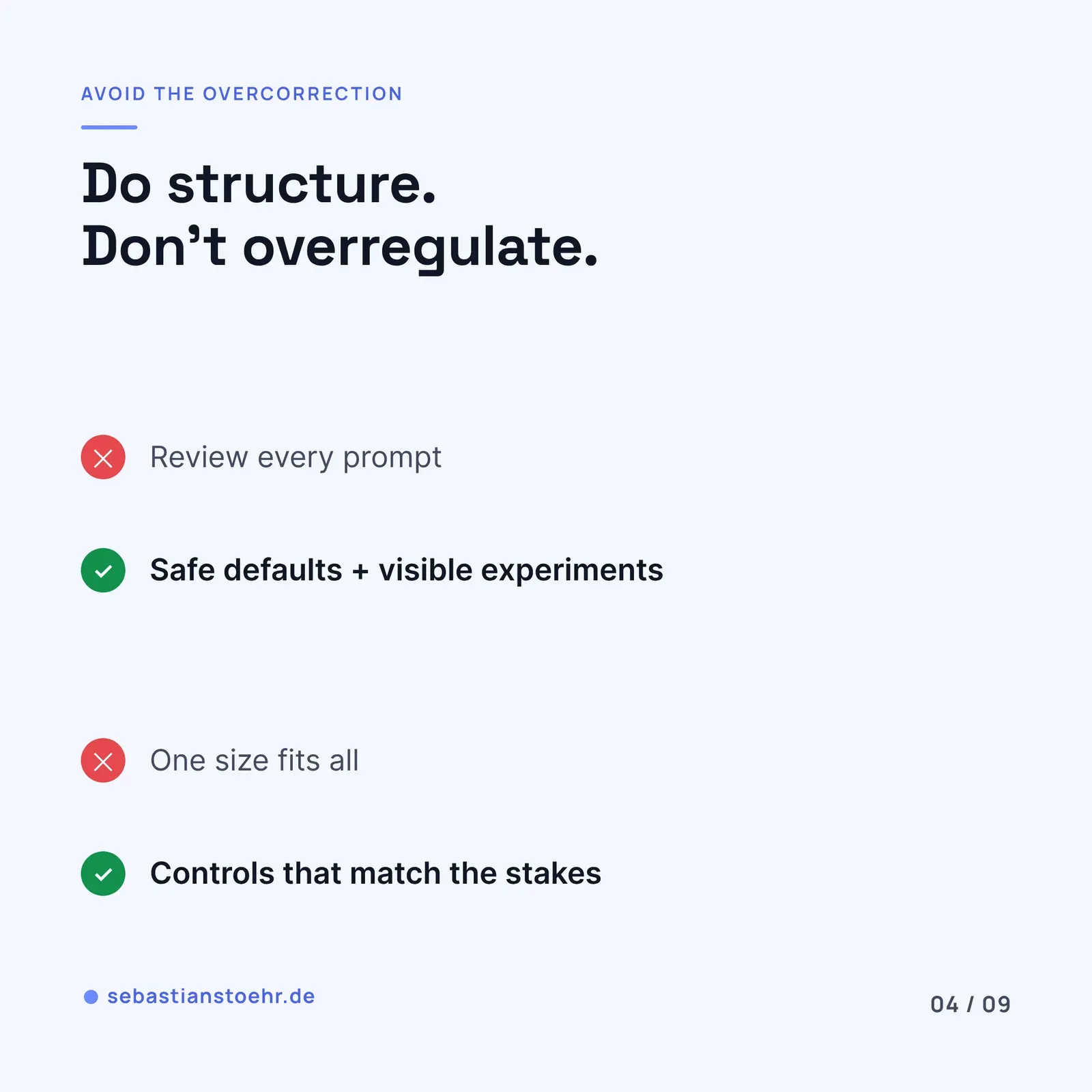
The instinctive response to sprawl is control. It starts with good intentions (protect data, manage cost, ensure compliance) and ends somewhere unhelpful: every experiment needs a business case, an architecture review, a security assessment, and a procurement sign-off before anyone can test a prompt.
This doesn’t make the organisation safer. It makes it slower and less informed. Central teams genuinely can’t see the exceptions, bottlenecks, and informal knowledge flows where the best workflows actually live. And motivated people don’t stop. They just go quiet. Now you have neither innovation nor control. You have hidden risk with extra paperwork.
There’s also a comforting illusion in over-centralisation: buy one enterprise assistant, declare the problem solved. It isn’t. People still need workflows, examples, knowledge access, quality gates, and a clear sense of where AI should and shouldn’t be trusted. A single login doesn’t create any of that.
Too little control breeds risk and duplication. Too much kills the learning you need to manage the risk.
The job is to do both at once, and that requires structure, not a single tool.
A toolbox, not a tool
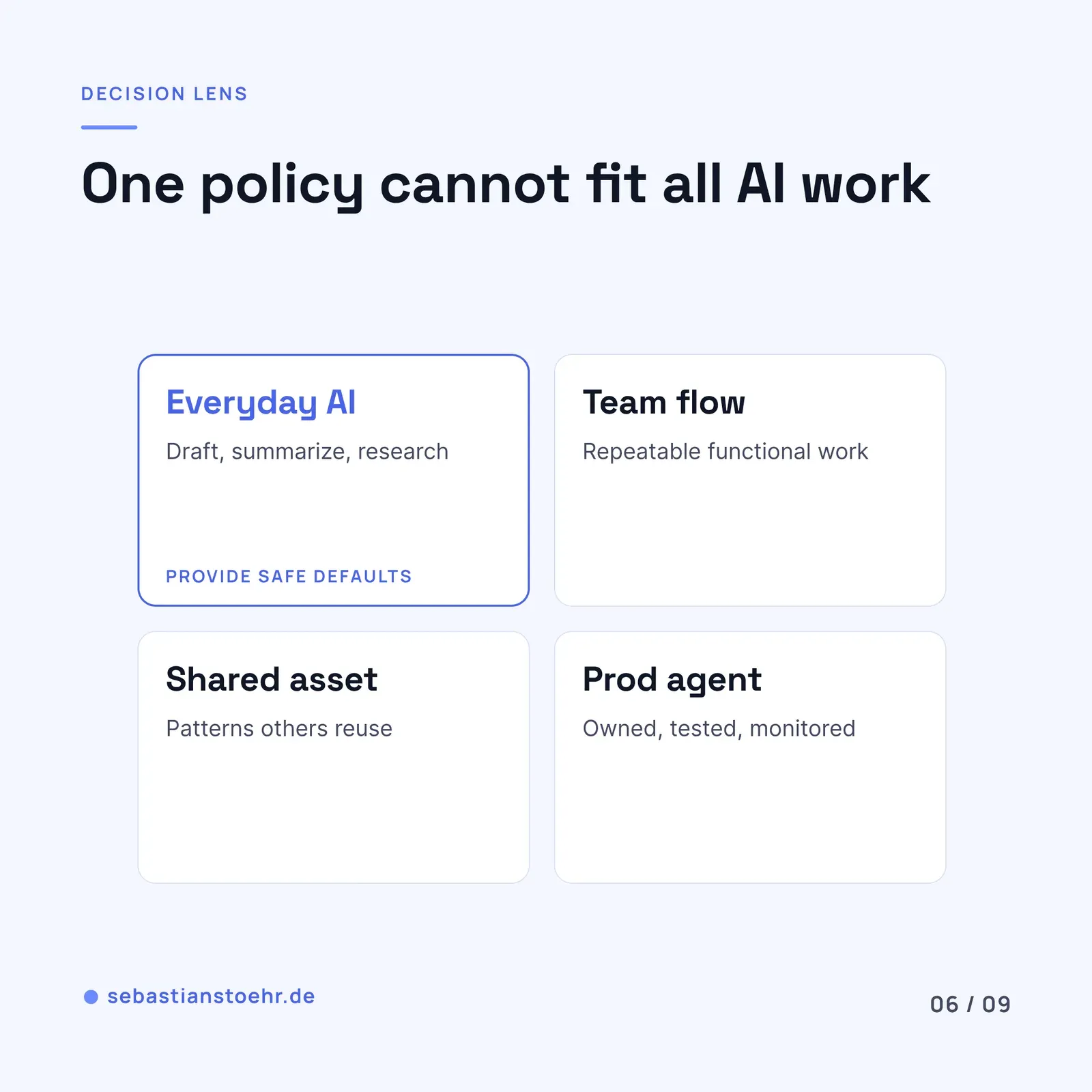
The way out of “one assistant for everyone” versus “let a thousand experiments bloom” is to stop treating all AI use as the same kind of thing. A brainstorming prompt and a production agent that writes to customer records do not need the same governance. Sorting work into layers lets each kind operate under controls that fit it.
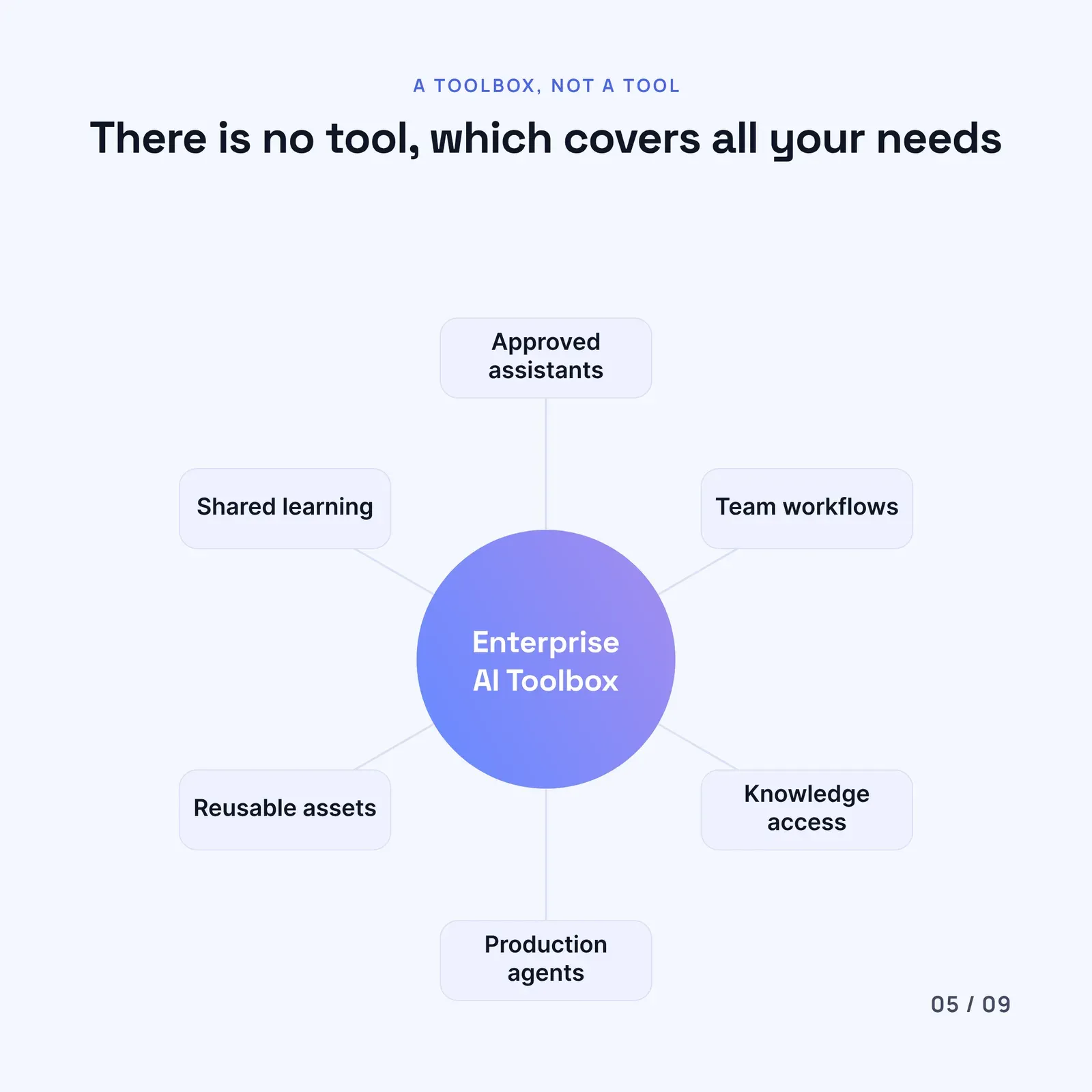
In practice I find it splits into roughly five:
- Approved general assistants for everyday work: drafting, summarising, translation, research. The point isn’t just blessing a tool; it’s giving people clear guidance on what data is fair game and what output needs a human check. This is the safe default that removes the incentive to paste company data into whatever’s open in another tab.
- Team-specific workflows tuned to one function: support-case summarisation, sales-proposal support, engineering assistance. Same platforms, maybe, but shaped around the language, documents, and review habits of an actual team. This is where AI stops being a generic chatbot.
- Shared knowledge access, because most of the valuable use cases depend on internal context – policies, product docs, project history, the why behind old decisions. Without managed access, every tool stays generic and people copy-paste context by hand. (You can read more about my approach to tackle this in my article “How to Turn Scattered Data into AI Intelligence”)
- Production-grade agents wired into business processes, with the engineering discipline that implies: testing, monitoring, fallback behaviour, access control, audit, ownership. A production agent is a managed system, not a clever prompt.
- Reusable assets: prompts, skills, evaluation sets, templates, patterns. This is the layer where learning compounds. A tested eval set for response quality, or a proven human-in-the-loop approval pattern, saves the next ten teams from starting at zero. Reuse is most of the difference between “we did experiments” and “we built a capability.”
The toolbox doesn’t remove choice. It makes choice safer and clearer.
 How to Turn Scattered Data into AI IntelligenceStop drowning in fragmented data and start building actionable intelligence. Learn how a specialized AI workflow can transform scattered documentation into a structured "source of truth," moving beyond simple search to enable deep organizational reasoning.sebastianstoehr.de
The bridge: let things graduate
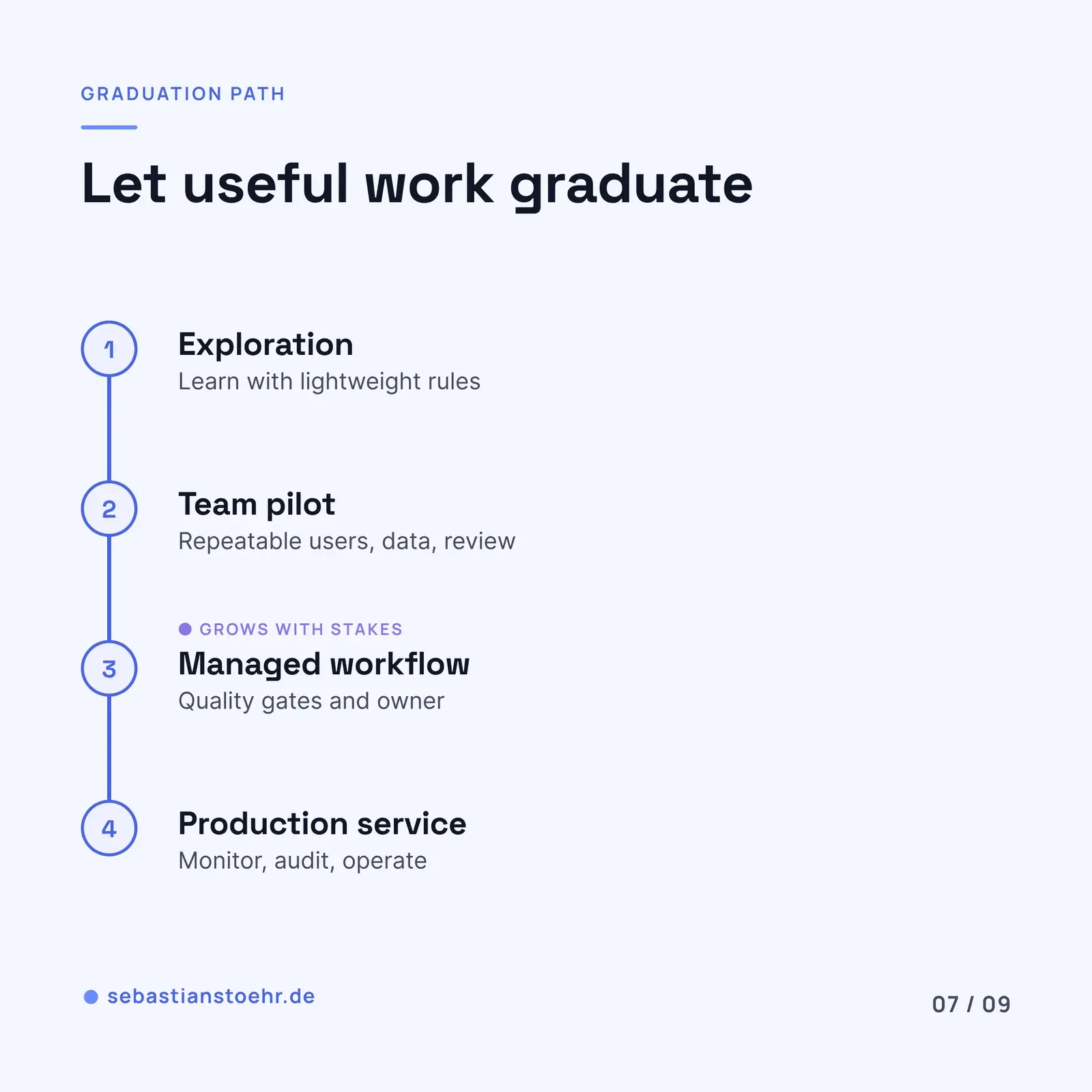
Layers tell you what kinds of AI work exist. They don’t tell you how something moves from a Friday-afternoon experiment to a system the business depends on. For that you need a path – a few stages each idea can graduate through, with expectations that grow as the stakes do.
Exploration is for learning: lightweight rules on approved tools and prohibited data, simple enough that people actually use them. A team pilot makes a workflow repeatable and writes down the basics – users, data, risks, who reviews the output. A managed workflow adds real quality gates: prompt versioning, sampled reviews, access control, a named owner. And a production service gets the full treatment – monitoring, logging, incident response, lifecycle ownership – because at that point it’s a business-critical capability like any other.
The value of the staged view is that it keeps experimentation alive and points everyone’s attention at the right risks. Not every brainstorm needs an architecture board. An agent that updates customer records does. Most organisations get this exactly backwards – heavy process on the harmless stuff, no process on the dangerous stuff – because they never made the path explicit.
Where to start on Monday
You don’t need the perfect operating model before you make progress. You need momentum, and the first move is almost always the same.
Map what’s already happening – without judgement. Not an audit, a discovery. Which tools, for which tasks, with what data, working well or not? Nearly every organisation skips this and jumps straight to policy, which is why the policy never fits. The map is the single highest-leverage thing you can do, and it costs you a few conversations.
From there it’s unglamorous and effective: define safe defaults so people aren’t reinterpreting vague policy every time; find the workflows that show up across multiple teams and make them shared assets; add lightweight quality gates (what’s it for, what data, who reviews, what could go wrong, who owns it – those five questions sort most cases); and make the path to production visible, so a team that’s outgrowing its experiment knows exactly what “real” requires instead of guessing.
Enterprise AI doesn’t mature by banning chaos on day one. It matures by learning from the early mess and turning that learning into a toolbox the whole organisation can pick up.
Stop Turning AI Chaos into policy theater
The post in a nutshell
Is it a problem when teams use AI tools without central approval?
Scattered, unapproved AI use is the normal first chapter of enterprise adoption rather than a governance failure. It becomes a problem when it never ends: sensitive data lands in tools never cleared for it, several teams rebuild the same workflow, quality standards differ in every corner, and business-critical workflows end up with no owner.
What belongs in an enterprise AI toolbox?
Roughly five layers: approved general assistants for everyday drafting and research; team-specific workflows tuned to one function; shared access to internal knowledge; production-grade agents wired into business processes with testing, monitoring and audit; and reusable assets such as prompts, skills and evaluation sets. The layers matter because a brainstorming prompt and an agent that writes to customer records do not need the same governance.
Does strict AI governance slow down adoption?
Requiring a business case, an architecture review, a security assessment and procurement sign-off before anyone can test a prompt does not make an organisation safer, only slower and less informed. Motivated people do not stop, they go quiet, which leaves hidden risk plus extra paperwork instead of either innovation or control.
How does an AI experiment become a production system?
Workflows graduate through stages as the stakes grow: exploration under lightweight rules, a team pilot that makes the workflow repeatable and records users and risks, a managed workflow with prompt versioning, sampled reviews and a named owner, and finally a production service with monitoring, logging and incident response.