The New Role of Engineering Leaders in AI Transformation
Why cheap implementation makes engineering judgment more valuable, and why leaders must turn private AI experiments into shared team capability.

A tidy assumption is spreading through engineering organizations: if AI can generate code, explain legacy systems, draft tests, and write documentation, engineering leadership must matter less.
I think the opposite is true.
AI does not shrink the leadership job. It raises the standard for it.
When implementation is the main constraint, weak judgment can hide for a while. Bad decisions take time to become shipped code - so there is enough time to detect and mitigate issues. When implementation gets cheaper, weak judgment becomes visible much faster. Teams can produce more output, but the harder question moves closer to the surface: what should we build, how do we know it is good, and who owns the decision?
The bottleneck moves from typing to deciding.
Engineering leadership becomes more important when implementation gets cheaper.
Faster code inside the same delivery system
Most engineering organizations start their AI adoption conversation too narrowly: how much faster can developers write code?
That question is useful, but incomplete. It assumes the rest of the delivery system stays unchanged.
A team that generates code twice as fast but still waits on unclear requirements, slow reviews, fragile environments, overloaded product ownership, and release approvals has not shortened the system. It has moved the queue. It may also have introduced new failure modes: plausible but wrong explanations, tests that confirm the implementation instead of the requirement, and security issues hidden inside confident output.
I saw this clearly while building an iOS app mostly with AI, a personal side project I wrote about in “Building an iOS app in just a day”. The biggest gain was not faster typing. It was getting from a vague idea to structured, sequenced, buildable work faster. Once the thinking was clear, the implementation became much less dramatic.
 Building an iOS app in just a dayDiscover how AI shifts the development process from mere coding to rapid requirements engineering and architectural sparring. This article explores a real-world experiment of building a functional, AI-powered iOS app.sebastianstoehr.de
AI changes the shape of delivery, not just its speed.
That is the shift leaders need to work with. The leadership question is not only “how do we help people write code faster?” It is also: how does AI change discovery, design, testing, review, incident response, onboarding, and knowledge sharing? And how do we redesign those workflows without losing accountability?
Make the learning visible
Teams learn through rituals. Stand-ups, planning, reviews, and retros are where “how we work” actually changes.
If AI stays in private chat histories, the organization learns slowly. One engineer discovers a useful way to analyze logs. Another finds a better approach for generating test cases. A third uses AI to understand a legacy module. Each person improves locally, but the team does not build shared capability.
Engineering leaders have to pull that learning into the open.
I would start with operating habits, not another enablement deck:
- Review the system bottleneck: Once a month, look at the whole delivery system. If AI helps engineers produce code faster, the bottleneck may shift to product clarification, PR review, staging environments, release approval, or support handover. The leadership job is to find the new queue, not celebrate local speed.
- Calibrate discovery: Put discovery under more pressure. When implementation gets cheaper, weak product judgment becomes more expensive. Building the wrong thing faster still creates no value. Engineering and product leaders should ask whether requirements validation is strong enough for the new pace of delivery.
- Show the workflow, not only the output: When a team finds a useful AI workflow for log analysis, test generation, service boilerplate, or onboarding, make the work visible. Which context did they provide? Which checks did they run? Which part is reusable? The repeatable parts should become supported patterns.
- Discuss AI in engineering conversations: Bring AI into 1-on-1s, pairing, reviews, and career development. Ask what people delegate, what they still practice deliberately, where they over-trust the tool, and where they avoid it because the rules are unclear.
- Run delivery retros focussed on AI: After larger features, incidents, or releases, ask where AI helped, where it misled, and which check, prompt, example, or review step should become part of normal delivery.
The point is not ceremony. The point is to convert private learning into organizational learning before every team invents its own partial version.
Safety is part of adoption
The tooling conversation often misses the human side of AI adoption.
Some engineers are enthusiastic. Some are skeptical. Some worry that relying on AI makes their skills look weaker. Others worry that not using it makes them look outdated. Juniors may over-trust output they cannot yet evaluate. Seniors may under-use tools because they see the risk first.
Leaders set the temperature here.
A healthy message sounds like this: “We are learning to use AI responsibly to improve our work. We expect experimentation, evidence, review, and shared learning.”
That makes two statements equally acceptable: “I used AI for this, and here is how I checked it” and “AI was not useful for this task.”
In AI transformation, psychological safety buys you reality over hype.
When leadership turns AI adoption into a mandate, the implicit pressure is to prove that it works. Without safety, engineers may waste hours fighting a tool just to make the initiative look successful. They may hide failures because they do not want to appear resistant. They may use AI where it slows the work down because the organization has made usage the visible signal.
That is bad management, not responsible adoption.
Teams need permission to report where AI helps, where it fails, and where the direct path is still better. Otherwise leadership gets adoption metrics and loses operational truth.
From private wins to shared capability
Strip the leadership task back to one sentence: convert scattered individual experimentation into organizational capability.
AI adoption usually starts as personal experiment. Better drafts. Faster prototypes. Quicker explanations. More confident navigation through unfamiliar code. Those gains matter, but they do not automatically compound.
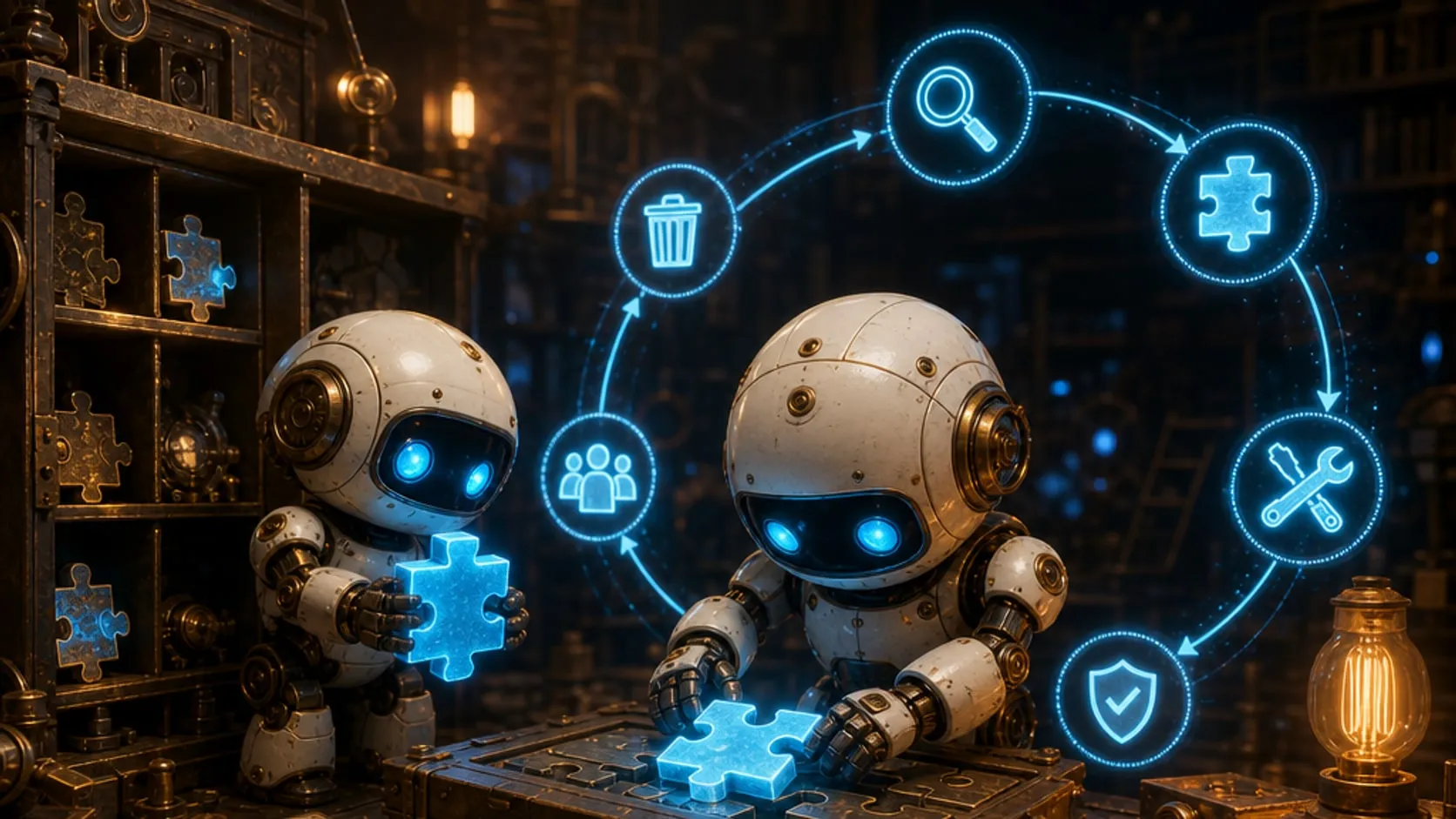
If every engineer learns alone, the organization gets fragmented improvement and duplicated discovery. The compounding loop is deliberate:
- spot the useful workflows already emerging
- evaluate them against actual work, not enthusiasm
- turn repeatable patterns into shared assets with owners
- teach them to the teams they fit
- retire the ones that do not earn their keep
That loop is leadership work. It requires judgment about where AI belongs in the delivery system, where quality gates are needed, where teams need freedom, and where standardization matters more than local preference.
It also requires restraint. Not every clever workflow should become a team standard. Not every automation deserves support. Not every personal shortcut should be turned into process.
The organizations that benefit most from AI in engineering will not be the ones running the most experiments. They will be the ones that learn fastest from experiments and fold that learning back into how they deliver.
AI accelerates implementation, but leaders shape the environment where implementation becomes valuable.
AI transformation does not remove the need for engineering leadership. It raises the standard.
The post in a nutshell
Why doesn't faster code generation make delivery faster?
A team that generates code twice as fast but still waits on unclear requirements, slow reviews, fragile environments and release approvals has not shortened the delivery system, it has moved the queue. Faster generation can also add failure modes: plausible but wrong explanations, tests that confirm the implementation rather than the requirement, and security issues hidden inside confident output.
How do engineering leaders stop AI learning from staying in private chat histories?
Make the workflow visible, not just the output. When a team finds a useful AI approach for log analysis or test generation, capture which context they provided, which checks they ran, and which part is reusable. Regular AI-focused delivery retros turn individual discovery into shared team practice.
Why does psychological safety matter for AI adoption in engineering teams?
When AI adoption is treated as a mandate, the implicit pressure is to prove the tools work, so engineers may fight a tool for hours or hide failures rather than look resistant. It has to be equally acceptable to say 'I used AI here and this is how I checked it' and 'AI was not useful for this task'.